Midwest bird watching
  • Home
  • Birds
    • Backyard Birds >
      • American Goldfinch
      • American Robin
      • Barn Swallow
      • Baltimore Oriole
      • Black-Capped Chickadee
      • Blue Jay
      • Carolina Chickadee
      • Dark-Eyed Junco
      • Downy Woodpecker
      • Eastern Bluebird
      • Hairy Woodpecker
      • House Wren
      • Mourning Dove
      • Northern Cardinal
      • Red-Winged Blackbird
      • Rose-Breasted Grosbeak
      • Ruby-Throated Hummingbird
      • White-Breasted Nuthatch
    • Non-Feeder birds >
      • Waterfowl
      • Wading Birds, Shorebirds & Gamebirds
      • Raptors
      • Doves, Cuckoos, Nighthawks & Whip-poor-will
      • Warblers
      • Small Non-Warbler Perching Birds
      • Woodpeckers & Kin
      • Sparrows & Kin
      • Swallows, Hummingbirds & Swifts
      • Blackbirds
  • Blog
  • Resources
    • Book Reviews
    • App Reviews
    • Free Downloads
    • Other Resources
  • Videos
  • Presentations
  • Photo gallery
  • Contact
  • Birding Locations
  • Checklist
  • Eliminate Predators
    • Cats
    • Others
  • Attracting Birds
    • Bird Feeders
    • Nesting Boxes
    • Plants
    • Food
    • Tools
    • Water Supply

Passenger Pigeons

4/30/2014

 
Picture
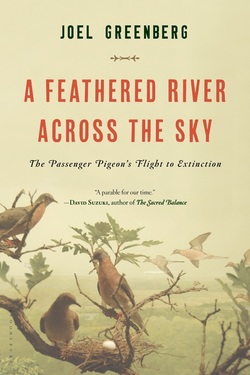
I have had the pleasure of reading Joel Greenberg’s book, “A Feathered River Across the Sky”, and I’ll have the privilege of listening to him speak this Saturday at the Indiana Audubon Society’s Spring Festival. This book should be required reading, not just for birders but for everyone, especially young people whose actions and decisions will have an enormous impact on the planet for decades to come.

First, I must be honest. Reading the book was not entirely pleasurable. I spent a great deal of time either with my fists clenched in anger or wiping back tears, not because of the quality of the writing (which is outstanding), but because of the horrible behavior demonstrated by the people in the book. While people may not be decimating the populations of plants and animals in the same way as they did the Passenger Pigeon, we are doing so in new, more modern ways. 

The Passenger Pigeon once numbered in the billions and constituted up to 40% of the continent’s birds. They were hunted relentlessly. Gene Stratton-Porter’s father abhorred the practice of shooting the pigeons and prophetically warned that if the massive killing of the birds did not stop, they may disappear. However, since they were so plentiful, Gene articulated the sentiment of the public, “that such a thing could happen in our own day as that the last of these beautiful birds might be exterminated, no one seriously dreamed”. And yet that is exactly what happened. The last Passenger Pigeon died 100 years ago. In 1860, more than a billion birds remained. In just 54 years, they were all gone.

Mr. Greenberg’s book serves to tell the tale of the Passenger Pigeon and to warn us that our actions can have catastrophic effects, not just on one species, but on every species with which that species interacts. The demise of the Passenger Pigeon, sadly, is not an isolated incident. Such losses continue today. The numbers of species threatened with extinction in Mr. Greenberg’s book are startling!

There is much that can be done. I think we need to start by developing a love of nature in young people. Bird watching, I believe, is one of the gateways to becoming a nature lover. It’s easy, it can be done anywhere and inexpensively, and it can appeal to everyone from someone who likes cute, tiny things like hummingbirds to someone who prefers lethal hunters like the Northern Goshawk. Only if you develop an appreciation of the natural world will you want to take steps to preserve it. But how do you turn young people into birders when it’s more “cool” to get a high score on the XBox? I’m working with Limberlost State Historic Site to develop a series of outreach programs designed for students. We discuss the impressive adaptations (which are far more “cool” than the animated creatures on the XBox), we explore the many ways in which birds help us, and we talk about ways that we can return the favor and help the birds. If the young children who attend the programs realize how interesting birds are, perhaps that love of nature will grow throughout their lives and they will be willing to act on behalf of those who cannot speak for themselves.

The loss of any species due to human action is inexcusable. I am grateful to Mr. Greenberg for writing this book and for doing so much to help raise awareness.


Great Lakes Webcast

4/29/2014

 
The Great Lakes region is important for the millions of birds that migrate through the area every year, using wetlands, forests, shoreline and more than 32,000 islands as stopover sites. But these habitats and others are under increasing pressure from climate change, habitat loss and other stressors.

Available online via live-stream, The Nature Conservancy and Detroit Public Television will present a panel of experts and video segments to explore these challenges and the solutions facing our feathered friends.

The program will live-stream on GreatLakesNow.org onTuesday, May 6th from 1 p.m. - 2 p.m. Preview videos are available on YouTube, here and here.

Author, blogger, columnist, educator and birding expert Sharon Sorenson will join the show as a special guest. Sorenson will illuminate how we all can be better hosts for birds in our backyards and around the world.

The program will be hosted by veteran journalist Christy McDonald and moderated by The Nature Conservancy’s Dr. Patrick Doran, director of conservation for Michigan.

Panelists include:

·      John Hartig, refuge manager of the Detroit River International Wildlife Refuge and board member of the Detroit Riverfront Conservancy

·      Melinda Pruett-Jones, former director of Chicago Wilderness and first-ever director of American Ornithologists’ Union.

In advance of the program, The Nature Conservancy will host a Twitter chat on Friday, May 2 at 1 p.m. using #glbirds. More information about the Great Lakes’ migratory birds, visithttp://nature.org/glbirds.


Outreach Programs

4/11/2014

 
Picture
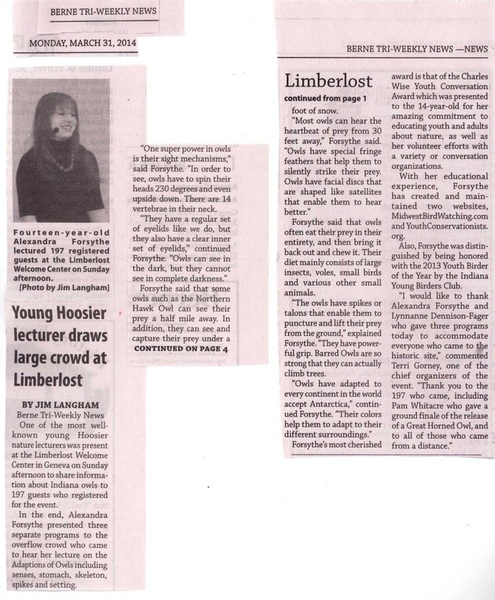
I have had the pleasure of working with the wonderful people at Limberlost State Historic Site to develop programs designed to encourage students to increase their awareness of the natural world. We’re creating in-house and outreach programs that cover a variety of interests from nature-friendly landscaping to the unique and diverse ways in which birds are beneficial to people. The in-house program I gave at Limberlost in late March focused on the owls of Indiana, their incredible adaptations, raptor rehabilitation and the many ways people can help these fascinating birds. The article attached to this blog describes some of that program. There are a few typos (owls do not dine on their pellets, they can turn their heads 270 degrees, etc.), but it is a very nice article. I was pleased to see that there was so much interest; I had to give the presentation three times that day in order to accommodate the overflow crowd!

The outreach program is designed to be taught in schools. The first of these presentations was given to a school in early April. I discussed the various methods of bird identification (physical characteristics, sound, behavior, nests, etc.) and some of the commonly overlooked ways in which birds help us. For example, the Yellow-Billed Cuckoo will feast on up to 100 tent caterpillars per sitting and is one of the few birds that will eat fuzzy caterpillars. Imagine the number of fruit trees that would be damaged if it were not for these wonderful birds keeping the tent caterpillar population under control! At the time of this writing, we have been invited by additional school districts to give programs in early May, so I am very encouraged!

We’re planning to expand the programs to cover additional subjects so that we can reach a broader range of interests. We want the next generation to gain a deeper appreciation of the world around them. The world is in their hands!


Luck O' the Irish!

2/23/2014

 
Picture
With St. Patrick's Day approaching, I thought it might be fun to look at a few of the birds that Indiana and Ireland share. 

The much maligned European Starling and House Sparrow were introduced to the United States and have become well-established. In fact, many birders consider them to be pests. While they are increasing or stable here, the House Sparrows have been declining rapidly in Europe, causing people to take steps to help these little birds. Products like "bird bricks" (bricks with large holes and hidden cavities) are being installed to provide more nesting sites. The colorful starling has also suffered from some decline in Europe but is currently stable in Ireland.

Indiana and Ireland also share the Canada Goose and Red-Throated Loon (or "Red-Throated Diver" as it is known in Ireland). The Canada Goose is not native to Ireland; it escaped from a waterfowl collection 300 years ago and is now thriving in the wild. The loon, on the other hand, is dangerously depleted.

We share several owls: Barn Owl, Short-Eared Owl, Long-Eared Owl and the Snowy Owl. Like those in Indiana, the Barn Owls of Ireland are having a difficult time. They are in rapid decline and have disappeared in many parts of Ireland. The Short-Eared Owls are rarely seen in Ireland, while the Long-Eared Owls are the most commonly seen owl. Snowy Owls are rare winter visitors to both Indiana and Ireland.

Happy St. Patrick's Day and Happy Birding!

Snow Buntings

2/7/2014

 
Picture
There’s a foot of snow on the ground, the wind is blowing and it’s currently below zero. These are certainly not the ideal conditions for birding! However, even in these conditions, there are some interesting birds to be seen from the warmth of your car.

One of my favorite birds is the Snow Bunting. I am fortunate to live in a rural area where farmlands and gravel roads abound. It’s the perfect location to find Snow Buntings. Large flocks gather along the plowed roadways, often in the company of Horned Larks and Lapland Longspurs. As your car approaches, the Buntings move in unison like a school of fish, flashing their bright white underwings as they fly low across the road. They are often shy, making photography difficult, but if you move very slowly, and if you are very lucky, you might be able to get a photo or two before they move just out of range yet again.


The Joys of Bird Banding

11/9/2013

 
Picture
When I go birding, I always hope that the birds will hop down onto a sunny branch with a beautiful background, strike the perfect pose, and hold still for a few minutes while I take photos. Of course, that never happens. If the bird does get close, it will inevitably turn its back to me and hide its face behind a leaf. Or there will be something undesirable like a dumpster in the background. If the bird is in the perfect spot with the perfect background, it will only be there until I grab my camera. As soon as my hands wrap around the camera, the bird flies off.

I love to see the birds up close for a few reasons. First, I love birds and I think they are all fascinating. Second, I love to take photos of birds. Third, even if you study all of the photos in field guides, it doesn't compare to studying a live bird up close. 

When you're banding birds, the setting and photography may not be ideal, but you really get to examine the bird. You learn the markings, character, and feel of the bird like no other setting can provide. You connect with the bird on a more personal level. I think participating in a banding program helps you become a better birder and a better steward of nature.

If you have the opportunity to participate in a bird banding program, I highly recommend that you do it. It will change the way you look at birds forever.


Autumn Maintenance

10/2/2013

 
Fall is a wonderful time for birders! Migrating birds are on the move, so you're sure to see several new feathered friends in your yard as they pass through. Autumn is also the time to perform some much-needed maintenance and cleaning to keep your birds healthy and happy.

Take notice of the birdhouses you put up. Did the intended birds use them? If not, you might consider changing the location of the nest box. For example, if a birdhouse is too close to your house, or too close to other nest boxes, House Sparrows tend to take over. Also, perform any maintenance on the birdhouses now and give them a thorough cleaning using a solution of one part bleach to nine parts hot water. Be sure to use a scrub brush and rinse thoroughly. A toothbrush is a great tool for those hard-to-reach places.

The bird feeders and the feeding area should be given a thorough cleaning as well. In fact, the feeders and bird baths should be cleaned regularly (weekly for feeders, daily for bird baths) throughout the year, but now is the time to do a little extra cleaning and maintenance. Scrub the feeders thoroughly inside and out with the bleach mixture, rinse thoroughly and allow to dry completely before refilling. Any moisture left in the feeders will lead to mold and can cause serious illness in the birds. Clean the perches and bird baths, as well, and collect and dispose of the empty hulls and the spilled, uneaten seed. 

Mice are actively searching for food sources at this time of year, so be sure to store your seed and suet in a secure container. Mice can carry diseases that affect birds so you'll want to keep them out of the birdseed. 

Watch for sales at garden centers on native, bird-friendly plants. Berry bushes, for example, are wonderful for birds and provide treats for you, too. Plant a few!

Those migrating birds may only stay in your yard a day or two, but they are a joy to behold and you certainly want to see them again in the spring! Please be sure to make their pit stop a safe and healthy one; keep the feeders, feeding area and bird bath clean.

Birdscaping

8/3/2013

 
What is birdscaping? Birdscaping is landscaping your yard in a bird-friendly manner, providing food, cover and nesting sites and materials via trees, shrubs and grasses.

Many of you already use bird feeders, and that is wonderful! The seed, nectar and other products you provide at your feeders are valuable supplements to your birds' diets, so you should keep your feeders clean and filled with high quality food. However, the food in those feeders is rarely a complete, balanced diet. Birds will need to seek other sources of vitamins, minerals, protein and other elements to stay healthy. So why not save them the trouble? Provide those natural foods in your yard!

In addition to providing a balanced diet of fruit, seeds, nectar and insects, if you choose your plants carefully, those plants will also provide shelter, nesting materials and nesting locations for your birds. Your yard will be a one-stop-shop for birds!

When choosing plants, always use native plants, particularly those that are adapted to your soil type and level of sunlight. Native plants are the natural foods for your birds - they are what your birds have grown to love and come to expect in your area. Your local extension office is the best source for determining the right plants for your yard.  

If possible, provide a mixture of heights: tall trees, short trees, shrubs and grasses. Some plant species have males and females. If you choose this type of plant, be sure to choose a female plant, or both a female and male in order to get fruit. Pay close attention to the time during which each plant will produce fruit. Try to choose plants that fruit at different times of year rather than all at the same time. Never spray or prune your plants during nesting season. In fact, try not to spray at all. If you get rid of the bugs, you'll get rid of the birds!

Make certain that the plants you choose are plants that you enjoy, too, either for their appearance or their fruit. If you like them, you’ll want to look outside more often, and if you’re looking outside, you might be amazed to discover which feathered newcomers have decided to make your yard their home!

Birding on a Budget

7/20/2013

 
In an ideal world we would all own top-of-the-line spotting scopes and we would have unlimited resources to go birding.  Sadly, we don’t have an ideal world; budgets can be tight and can seemingly hinder our ability to participate in our favorite activity.

All is not lost!  Birding can easily be done on a budget.  Opportunities to bird with little or no money surround you!

Start in your back yard and in your neighborhood especially during Spring migration.  You’d be surprised at the variety of species that will stop by your home to rest during their long journey.  Many of the birds may only be there for a couple of hours or days, so be sure to check frequently.  Make sure you supply fresh water daily to provide added incentive for the birds to stay a while.  We all love to go see the birds, but having a bird grace your yard with its presence is a special treat.  You’ve been chosen!

It might be difficult to believe, but parking lots are often wonderful birding opportunities.  I have found several lifers in grocery store parking lots.  Keep your eyes peeled every time you have errands to run and give yourself a few extra minutes to look around.  You never know what you’ll find!

Another local and inexpensive resource is the park system.  Many state, county and city parks have free bird watching programs.  For the low cost of admission, you’ll often have the benefit of expert birders and spotting scopes, not to mention superb habitat.

Finally, don’t forget your local Audubon society.  With nearby field trips, these birding enthusiasts will be happy to show you fantastic birding areas that are often overlooked from cemeteries to rock quarries.

One of the best things about birding is that it doesn’t have to be expensive.  Anyone, anywhere can go bird watching!

Birding on a cruise ship

5/27/2013

 
My idea of the perfect vacation would of course be a week of non-stop birding.  Believe it or not, however, the rest of my family likes doing other things.  Can you imagine that?  Ha!

This year, my family vacationed on a cruise ship in late November.  We drove from Indiana to Texas to board the ship.  I saw a few birds along the way as we rocketed through the states.  Missouri and Arkansas had quite the welcoming committee of Red-Tailed Hawks.  They were posted like sentries along the highway.  We were a little surprised at the number and consistency of the hawks so we started counting.  On average we saw two Red-Tailed Hawks every mile.  Most rodent-free (or rodent-filled) highways ever!

My parents were kind enough to screech to a halt now and then and make some u-turns so I could get better views and photos of some of the birds along the roads and highways from Texarkana to Galveston.  I spotted a Harris’s Hawk, several Crested Caracaras, and a White-Tailed Kite.  At a traffic light in Austin, we were surrounded by Monk Parakeets.

In Texas, my parents spent a day being nostalgic.  My older brother, Scott, was born in Austin, Texas (a proud native Texan!), but my parents moved when he was a baby.  They wanted to show him their old home and some of their favorite places.  Naturally, I watched for birds at each location. 

We stopped at one of my parents’ favorite restaurants in the hill country – The Oasis – and in the parking lot I was surprised to find several Lesser Goldfinches!  While Scott climbed Enchanted Rock nearby, I scoured the brushy areas below and found White-Winged Doves, Inca Doves, Bewick’s Wren and Black-Crested Titmouse.

On the way to Galveston where we would board the ship, my parents squeezed in a very short stop at Aransas Wildlife Refuge for me.  I was lucky to be there when they were having a special birdingprogram with a naturalist who was an expert birder.  I saw Whooping Cranes, Great Kiskadee, Reddish Egret, Long-Billed Curlew, Ladder-Backed Woodpecker and Roseate Spoonbill.

We also squeezed in some birding in Galveston just before boarding the ship.  On the Texas City Dike I saw several American Pipits and White-Faced Ibis.  Also in the Galveston area, I saw a Piping Plover, Dunlin, Nelson’s Sparrow, Mottled Duck, Black-Necked Stilt, Neotropic Cormorant, Marbled Godwit, Reddish Egret, Seaside Sparrow, White-Tailed Kite and Yellow-Crowned Night Heron.

It’s not easy birding from a cruise ship, but it can be done!  You just have to get creative.  I watched for birds from our balcony, the docks and during the shore excursions.

There were surprisingly few birds at the docks and almost none as we cruised along in the ocean.  There were the typical gulls and terns, but I did manage to snag one lifer at one of the docks in Mexico – a Black Tern.

During the shore excursions in the Caymans and Mexico, I had to bird from my seat in the tour busses and during the tours themselves.  Some tours were easier to bird in than others; some tour guides were flexible but some were rather rigid.

In the Caymans, we made several stops across Grand Cayman Island in different habitats, so I saw a nice variety of birds.  I saw Smooth-Billed Ani, Bananaquit, Yellow-Billed Cacique, Greater Antillean Grackle, Hooded Oriole and others.

In Mexico, I spotted some wonderful birds during our shore excursions.  I had to wander away from the tour groups now and then, but it was worth it!  I saw a Turquoise-Browed Motmot, Keel-Billed Toucan, Brown Jay, Black-Headed Saltator, Military Macaw, Bronzed Cowbird, Melodious Blackbird, Altamira Oriole, and many more.

I may not have been able to spot as many lifers during the trip as I would have if it were abirding trip, but I was able to do so many other fun things so I can’t complain.  It was an awesome vacation! 
<<Previous
Forward>>

    Author

    Alex Forsythe

    Archives

    May 2020
    April 2020
    July 2016
    May 2016
    March 2016
    February 2016
    October 2015
    July 2015
    June 2015
    May 2015
    April 2015
    March 2015
    February 2015
    January 2015
    December 2014
    November 2014
    October 2014
    September 2014
    August 2014
    July 2014
    June 2014
    May 2014
    April 2014
    February 2014
    November 2013
    October 2013
    August 2013
    July 2013
    May 2013
    February 2013
    December 2012
    October 2012

    Categories

    All

    RSS Feed

Powered by Create your own unique website with customizable templates.
